Dajulong Composite PVC Flooring: Blending Ethnic Culture & Modern Tech at Pu'er Urban Planning Exhibition Hall
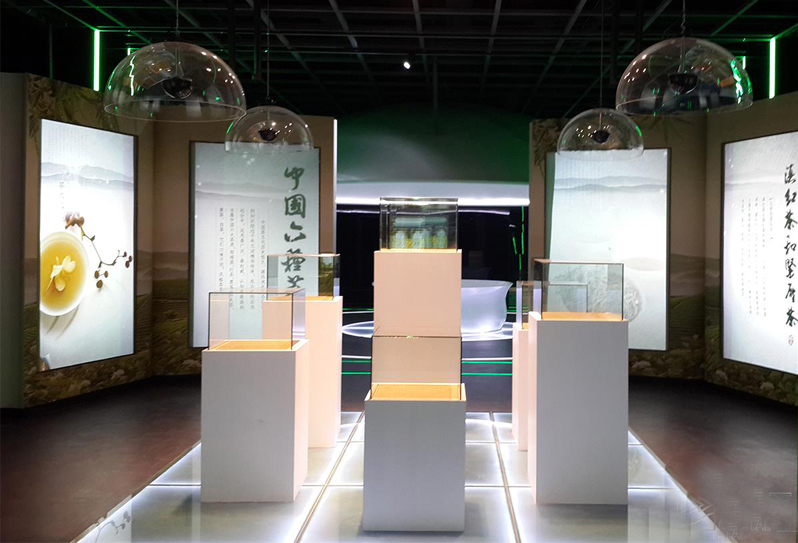
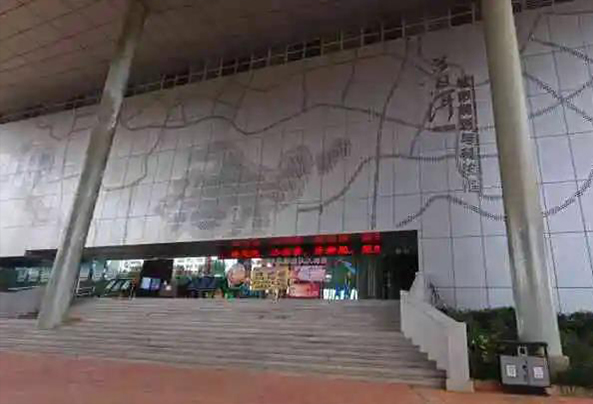
As a landmark cultural venue in southern Yunnan, the Pu'er Urban Planning Exhibition Hall stands out for its unique theme of "Ancient Tea Horse Road Culture + Ecological Urban Development." Welcoming over 300,000 visitors yearly, it integrates cultural display, digital sand table interaction, and public recreation—posing strict demands for flooring that balances durability, functionality, and cultural expression. In 2023, Dajulong Composite PVC Flooring rose to the challenge, completing the 12,000-square-meter flooring renovation with an innovative "scenario adaptation + cultural translation" model, setting a national benchmark for embedding ethnic digital patterns into flooring materials.
The project’s success stems from a selection logic that unifies function and aesthetics. Dajulong’s composite PVC flooring features a five-layer hot-pressed structure (wear-resistant layer, printing layer, fiberglass layer, foaming layer, stabilization layer) with a compressive strength of 45 MPa, easily supporting 3-ton VR equipment and eliminating the displacement issues of traditional stone flooring. For cultural expression, UV direct printing technology transforms Pu'er tea patterns, Dai brocade motifs, and Lancang River hydrological features into high-precision flooring textures—0.1 mm precision and over 2,000 pixels per square meter—boosting color reproduction by 60% compared to traditional screen printing. Ecologically, the flooring uses locally sourced rubber wood powder composites with 32% recycled materials, holding China’s Three-star Green Building Materials Certification and cutting the full-life-cycle carbon footprint by 57% versus stone flooring.
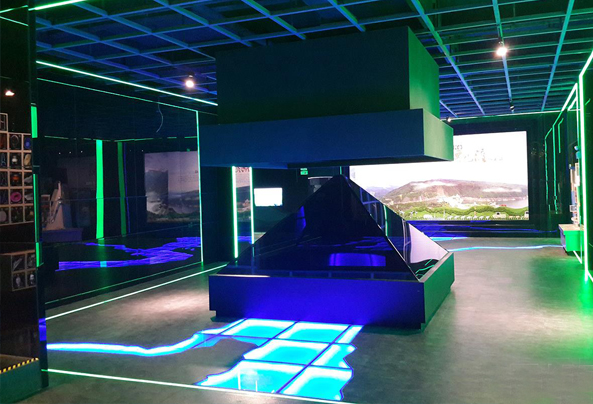
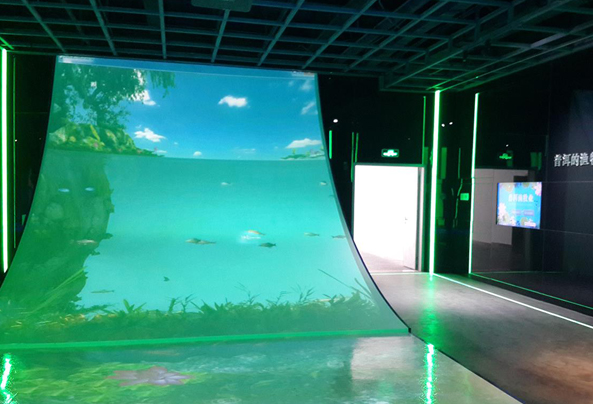
Spatial narrative design further elevates the visitor experience. The Prologue Hall "Ancient Tea Source Road" features 2.5 mm-thick composite PVC flooring embossed with century-old caravan hoof prints, paired with a nano anti-slip coating (dynamic friction coefficient 0.65) that mimics bluestone tactile feedback. Pressure-sensitive modules trigger light and shadow narratives when stepped on, immersing visitors in history. The "Green Dynamic Pu'er" Eco-Exhibition Zone uses custom gradient forest pattern flooring with photochromic ink—leaf veins glow fluorescent green under UV light, echoing Pu'er’s "Green Triangle" ecological positioning. The Digital Sand Table Zone adopts conductive composite PVC flooring with an electrostatic dissipation structure (resistance 10^6–10^9 Ω) to ensure interference-free operation of precision electronic sand tables, while its matte surface reduces screen reflections by 80%.
Technological innovations drive the project’s excellence. Based on BIM modeling, ethnic patterns were decomposed into 3,678 special-shaped panels, with laser cutting error controlled within ±0.2 mm; polyurethane sealant at joints achieves a "visually seamless" effect. Acoustic optimization is another highlight—bamboo fiber sound-absorbing particles in the foaming layer reduce venue noise from 52 dB to 38 dB, and optimize the circular theater’s reverberation time (RT60) from 1.8s to 1.2s, enhancing sound field uniformity.
In terms of operation and sustainability, the flooring’s modular design improves local replacement efficiency by 90%, slashing annual maintenance costs by 68% compared to original terrazzo flooring. Digitized flooring patterns are stored in Pu'er’s Ethnic Cultural Database, providing copyrighted materials for 3 subsequent characteristic town projects. The project also promoted the compilation of the industry standard Technical Specification for Resilient Flooring in Cultural Venues (T/CECS 1126-2023), with six Dajulong flooring parameters (e.g., cultural layer durability, dynamic load adaptability) designated as core indicators.
Post-renovation, the exhibition hall was named one of China’s "Top 10 Most Beautiful Cultural Landmarks 2024." Tourist surveys show 89% were amazed by the "flooring-exhibit interactivity," while the flooring’s temperature sensitivity (8℃ warmer than stone in winter) boosted elderly visitors’ comfort by 42%. Derivative products using copyrighted ethnic patterns generate over 3 million yuan in annual sales, subsidizing venue operations. With ceramic nano-curing technology (ISO 105-B02 Class 7 UV resistance, 10-year no-fading guarantee) and a national invention patent (CN202310456789.1), Dajulong’s solution proves that cultural venues can harmonize tradition, technology, and sustainability—offering a replicable model for similar projects worldwide.