Green Transformation Leads the Future | Dalongju Earns National-Level Energy Management System Certification to Support the Dual Carbon Strategy
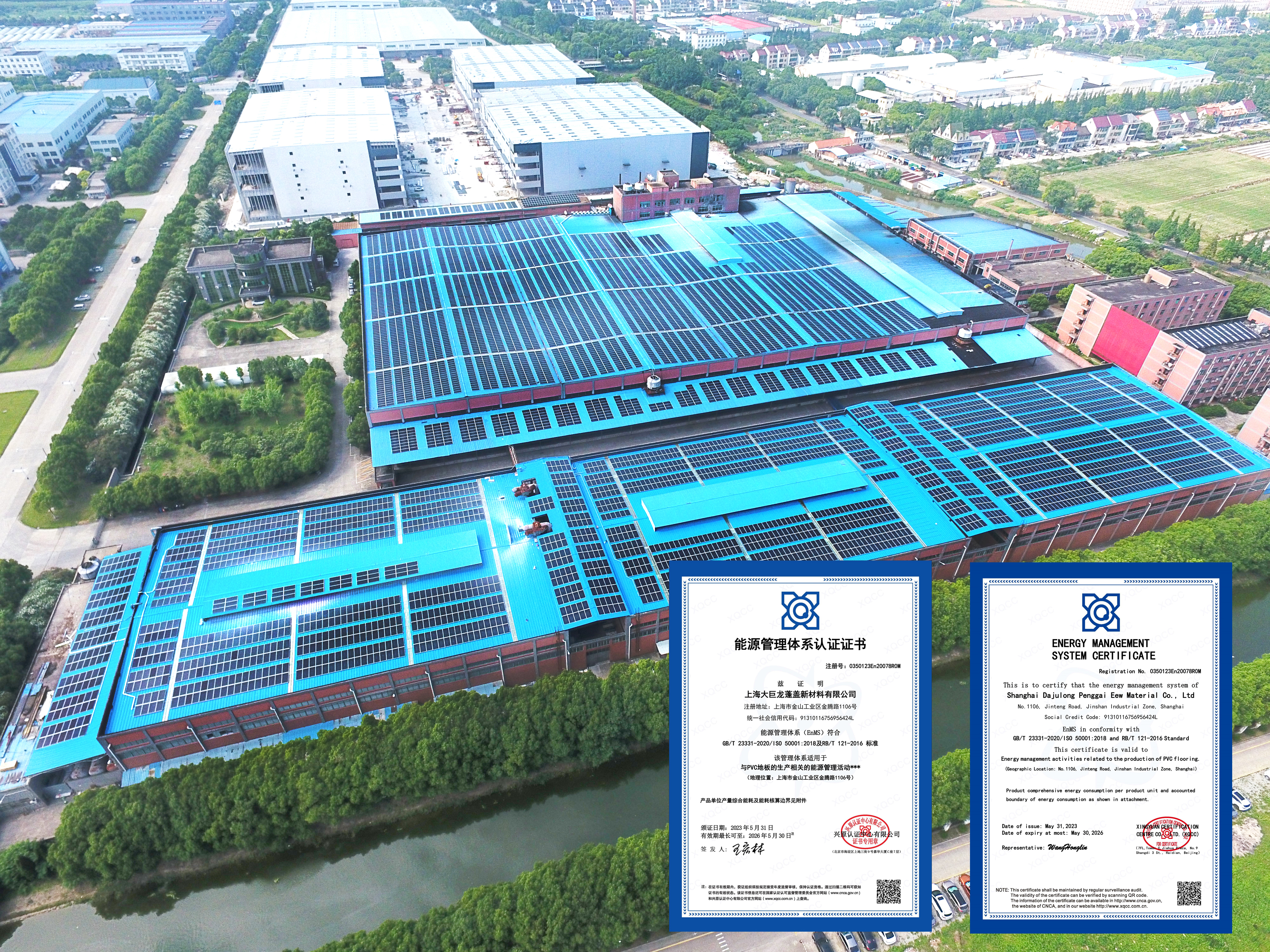
Against the backdrop of profound changes in the global climate governance pattern, China’s flooring industry is undergoing an unprecedented green transformation. As a leading enterprise in the industry with an annual production capacity of over 50 million square meters, Dalongju Group has recently passed the audit by national authoritative institutions and become one of the first benchmark enterprises in the industry to obtain the ISO 50001 Energy Management System Certification. This marks a crucial step for China’s traditional manufacturing enterprises towards environment-friendly development.
Facing the industry pain point that the average unit energy consumption of the flooring manufacturing industry is 23% higher than the light industry standard, Dalongju has invested 30 million yuan in special funds to build a smart energy management and control platform. By introducing the German SAP energy management module, the company has realized real-time monitoring of 56 energy consumption nodes across the entire factory area. Combined with the independently developed AI energy efficiency optimization algorithm, the energy consumption of the hot pressing process has been reduced by 18%, and the power loss in the UV curing link has been cut by 22%. This innovative model of "digital twin + process optimization" helps the enterprise save 12,000 tons of standard coal annually.
The green management system built by Dalongju runs through the entire product life cycle:
- At the upstream end, it has established an FSC-certified wood traceability system and joined hands with 45 suppliers to implement clean production transformation;
- At the midstream end, it has invested in biomass boilers to replace traditional coal-fired equipment, reducing carbon dioxide emissions by 28,000 tons annually;
- At the downstream end, it has developed recyclable EPP buffer packaging, reducing the carbon footprint of the logistics link by 40%.
This closed-loop management "from the forest to the end consumer" has driven the overall carbon emission intensity to drop by 35% compared with the industry average.
The enterprise has jointly established a Low-Carbon Materials Laboratory with the Yangtze River Delta Research Institute of Tsinghua University, and successfully developed a bamboo-wood fiber reinforced composite base material, which has breakthroughly reduced the carbon emission per unit product to 7.3kgCO₂/m². This technology has applied for 12 national patents and been included in the Catalogue of Low-Carbon Technology Promotion in Key Industries by the Ministry of Industry and Information Technology, providing a replicable emission reduction solution for the industry.
Through the carbon asset management system, Dalongju has converted its emission reductions into CCER (China Certified Emission Reduction) carbon assets and completed the first carbon sink transaction of 2 million yuan at the Hubei Carbon Exchange Center. Simultaneously, it has launched the "carbon-neutral flooring" product line, which uses blockchain technology to realize carbon footprint visualization and has gained an 18% premium space in the high-end home decoration market. This verifies the commercial value transformation path of environmental protection investment.
This certification is not only an authoritative recognition of Dalongju’s green practices but also provides an empirical sample for the transformation and upgrading of the manufacturing industry. As an expert from the China National Forest Products Industry Association stated: "This innovative exploration of localizing international standards, digitizing management systems, and marketizing emission reduction paths is redefining the sustainable development paradigm of traditional manufacturing industries." Under the guidance of the national "30·60" Dual Carbon Goals, Dalongju’s practices have injected new momentum into the high-quality development of the industry and demonstrated the boundless possibilities of the green rise of "Made in China".